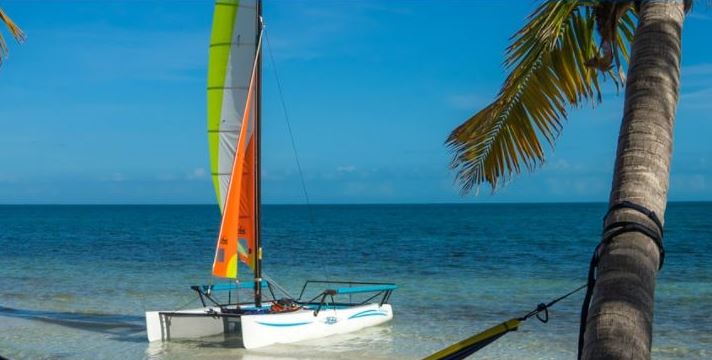
A multi-year expedition consisting of the most amazing snorkeling, conventional air & nitrox diving, reef observation, and cultural immersion — all done with the "Shamrocket" — a Hobie Getaway catamaran.
Two circuits. Two oceans. A multi-year coastal sailing and reef observation expedition — structured reef observation by day, extraordinary living by night, and a story for the ages being written one memorable day at a time. Wind and solar only. Zero carbon. Zero compromise.
Led by Daniel Roe — U.S. Coast Guard–licensed 200-Ton Master Captain, ASA sailing instructor, former U.S. Navy submariner, FAA-licensed drone pilot, Lean Six Sigma Black Belt, and expedition sailor who has been doing hard things on the water since before most sailing influencers were born.
One credential doesn't fit on a tag but shapes everything: qualifying in submarines in the U.S. Navy's nuclear program. When a submarine is submerged, it is a sealed world. No signal. No backup. No helpdesk. Every qualified watchstander owns their domain completely — because there is no one else coming. You solve every problem, at any location, with what you know and who you are. That discipline never leaves you. It is exactly how this expedition is designed and run.
Modern Y-DNA work traces his paternal line through the I1 haplogroup to Thorvald Asvaldsson, Erik the Red, and Leif Erikson. He sails as Ove Ironhand. This combination shapes everything: calm decision-making, conservative risk management, genuine curiosity about the people and cultures of every coastline — and preparation over bravado. The life is extraordinary because the standards are real.
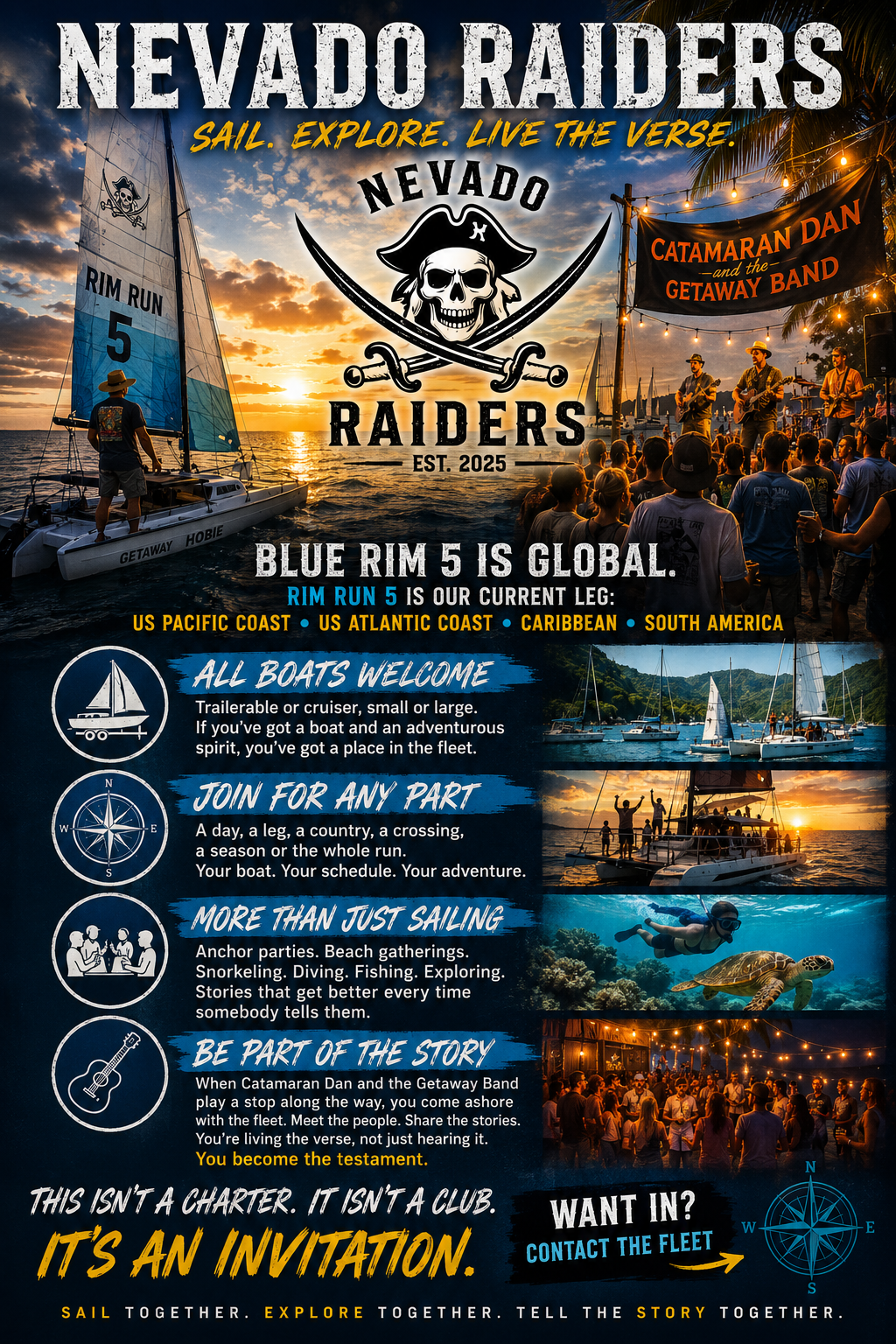
The sailing identity and the mission are carried under the flag of the Nevado Raiders™ — a name that has been in active circulation for more than three years, applied to every vessel, every circuit, and every field operation that carries this standard.
Daniel Roe — Catamaran Dan
Ove Ironhand
Nevado Raiders™ — Est. 3 Years
The Rim Run™ expedition operates in two distinct circuits — one on each side of the American isthmus. Rim Run Caribe™ covers the Caribbean coast from Mexico south through Central America to Colombia and the ABC Islands. Rim Run Pac™ crosses the Panama isthmus by trailer and runs the Pacific coast from Panama south toward Chile, returning north through Central America to the Sea of Cortez.
Together they form the most comprehensive two-ocean coastal reef observation program ever executed from a single small-boat platform by a single operator.
Caribbean coast from Mexico to Colombia, including Aruba, Bonaire, and Curaçao. The Mesoamerican Barrier Reef, Bay Islands, San Blas, Colombian coral gardens, and world-class shore diving at Bonaire.
Panama isthmus crossing to the Pacific — south toward Chile via Colombia, Ecuador, and Peru, then north through Central America to the Sea of Cortez. Galápagos, Cocos Island, Humboldt Current.
The Rim Run™ is a two-person expedition. Every circuit, every ocean, every anchorage — two people on a purpose-built catamaran doing real work in real conditions. The second seat belongs to the right woman.
Not a passenger. Not a deckhand. A partner. Seamanship, judgment, calm under pressure, and the kind of curiosity that makes a coral reef worth diving at the end of a long passage day. Someone who wants the greatest adventure of her life and is ready to earn every mile of it.
If that sounds like you — there's a page written directly to you. It tells the truth about what this life is, what it asks, and what it gives back.
Are You the Shield Maiden? →
Anchor down — the Rim Run way
The Coastline Circuit — From the Mesoamerican Reef, the route slips south along low-lying tropical coasts and scattered cays past Belize and Honduras, then hugs jungle-lined shores through Nicaragua, Costa Rica, and Panama into the reef-dotted waters of Colombia and the ABC Islands.
Life Ashore — Cultural Exchange
From Mexico's Yucatán south through Central America to Colombia's Caribbean coast and the ABC Islands — 2,000+ nautical miles, multiple reef systems, and some of the most scientifically significant and least-surveyed waters in the western hemisphere. The same loop every year, refined each season. No leg is hurried, and no place is passed without respect for the people, the governments, and the coastlines that define each shore.
| Country | Key Stops | Days | Why It Matters |
|---|---|---|---|
| 🇲🇽 Mexico | Puerto Aventuras · Cozumel · Xcalak · Banco Chinchorro | ~30 | Northern hub — REEF coordination & staging |
| 🇧🇿 Belize | Ambergris · Turneffe · Lighthouse Reef · Blue Hole · Glover's · South Water · Placencia | ~117 | World's 2nd largest barrier reef — home waters & citizen science base |
| 🇬🇹 Guatemala | Livingston · Río Dulce · Lake Izabal | ~35 | Most stunning inland waterway in the Americas |
| 🇭🇳 Honduras | Cayos Cochinos · Utila · Roatán · Guanaja | ~80 | Bay Islands — whale sharks & 100+ ft visibility |
| 🇳🇮 Nicaragua | Big Corn Island · Little Corn Island · Pearl Cays | ~29 | Priority Year 1 — essentially unsurveyed |
| 🇨🇷 Costa Rica | Tortuguero · Cahuita NP · Puerto Viejo | ~35 | Southern Caribbean transition zone — reef, river, jungle, and protected coastline |
| 🇵🇦 Panama | Bocas del Toro · Escudo de Veraguas · Guna Yala / San Blas | ~70 | Southern hub — long-duration anchorage, biodiversity, and expedition reset point |
| 🇨🇴 Colombia | Cartagena · Islas del Rosario · Santa Marta · Tayrona | ~30 | CORDAP partnership theater — Caribbean coral data & KAUST collaboration |
| 🇦🇼 Aruba | Oranjestad · coastal reefs | ~10 | Dutch territory — stable, distinct coral ecosystem west of the ABC chain |
| 🇧🇶 Bonaire | Kralendijk · Klein Bonaire · shore dive sites | ~14 | Premier shore diving destination on earth — hookah system deployed, lionfish hunting |
| 🇨🇼 Curaçao | Willemstad · Klein Curaçao · coastal reefs | ~10 | UNESCO-recognized harbor — southern Caribbean data anchor |
After the Caribe circuit, Shamrocket crosses the Panama isthmus by trailer and enters the Pacific. The Pac circuit runs south along the Pacific coast through Colombia, Ecuador, and Peru toward Chile — then returns north through Central America and into the Sea of Cortez, completing the circuit at La Paz, Mexico after a full sweep of the Cortez. Two entirely different ocean systems, thermal regimes, and reef ecologies. The same platform. The same discipline.
| Location | Key Stops | Why It Matters |
|---|---|---|
| 🇵🇦 Panama Pac | Panama City · Pearl Islands · Coiba NP | Isthmus entry — Pacific transition, Coiba's UNESCO reef system |
| 🇨🇴 Colombia Pac | Bahía Solano · Nuquí · Gorgona Island | Humpback nursery grounds, remote Pacific reef systems |
| 🇪🇨 Ecuador | Esmeraldas · Manta · Machalilla NP | Humboldt Current interface — where cold upwelling meets tropical reef |
| 🇵🇪 Peru | Tumbes · Máncora · Paracas | Cold current transition zone — marine diversity driven by upwelling |
| 🇨🇱 Chile | Northern coast · Atacama coastal waters | Southern terminus — extreme cold-warm boundary, endemic species |
| 🇨🇷 Osa Peninsula | Drake Bay · Corcovado | Northbound return — one of the most biodiverse coastal zones on earth |
| 🇲🇽 Sea of Cortez | Cabo Pulmo · Loreto · La Paz | Northern terminus — "Aquarium of the World," UNESCO reef at Cabo Pulmo, full Cortez sweep ending at La Paz |
Rim Run™ is not just an expedition. It is the field platform for the greatest coastal sailing and reef observation expedition ever attempted.
Regional Science Network
The Caribbean Coastal Reef Alliance (CCRA) is the long-term citizen science framework connecting reef observers, partner institutions, and aligned coastal stakeholders across the Rim Run Caribe™ countries.
Documenting the Human Story
The Living Saga™ is the documentary and media arm of the expedition — the reefs, the coastlines, the people, the boats, the weather, the culture, and the reality of living this life year after year. It exists so the world can see what is being protected, what is changing, and what still remains worth fighting for.
The Living Saga™ →The Rim Run™ is the first operating chapter of Blue Rim 5™ — the larger global sailing expedition model that will eventually extend far beyond the western Caribbean. The first years are about proving the platform, establishing credibility, building a regional science network, and generating a repeatable field record where it matters most.
That means the early work is intensely local in method and global in significance: small boats, disciplined observation, reef systems under pressure, and a public-facing record grounded in real-world continuity rather than abstraction.
Blue Rim 5™ — First Chapters
Shamrocket — Expedition Platform
The reef work matters. The science matters. But the life built around it matters too. The evenings at anchor, the food, the weather, the stories, the people, the rituals, the silence, the music — this is not some decorative side element to the mission. It is the other half of it.
What the Mint Julep is to horse racing, Bourbon Storm™ is to the yachting community. Born on a blue-sky equatorial Pacific day in 1984 that turned dark, wet, and alive — then cleared just as fast. The recipe remained private for forty-one years. It belongs to the water and to the evenings the water gives you when you've earned them.
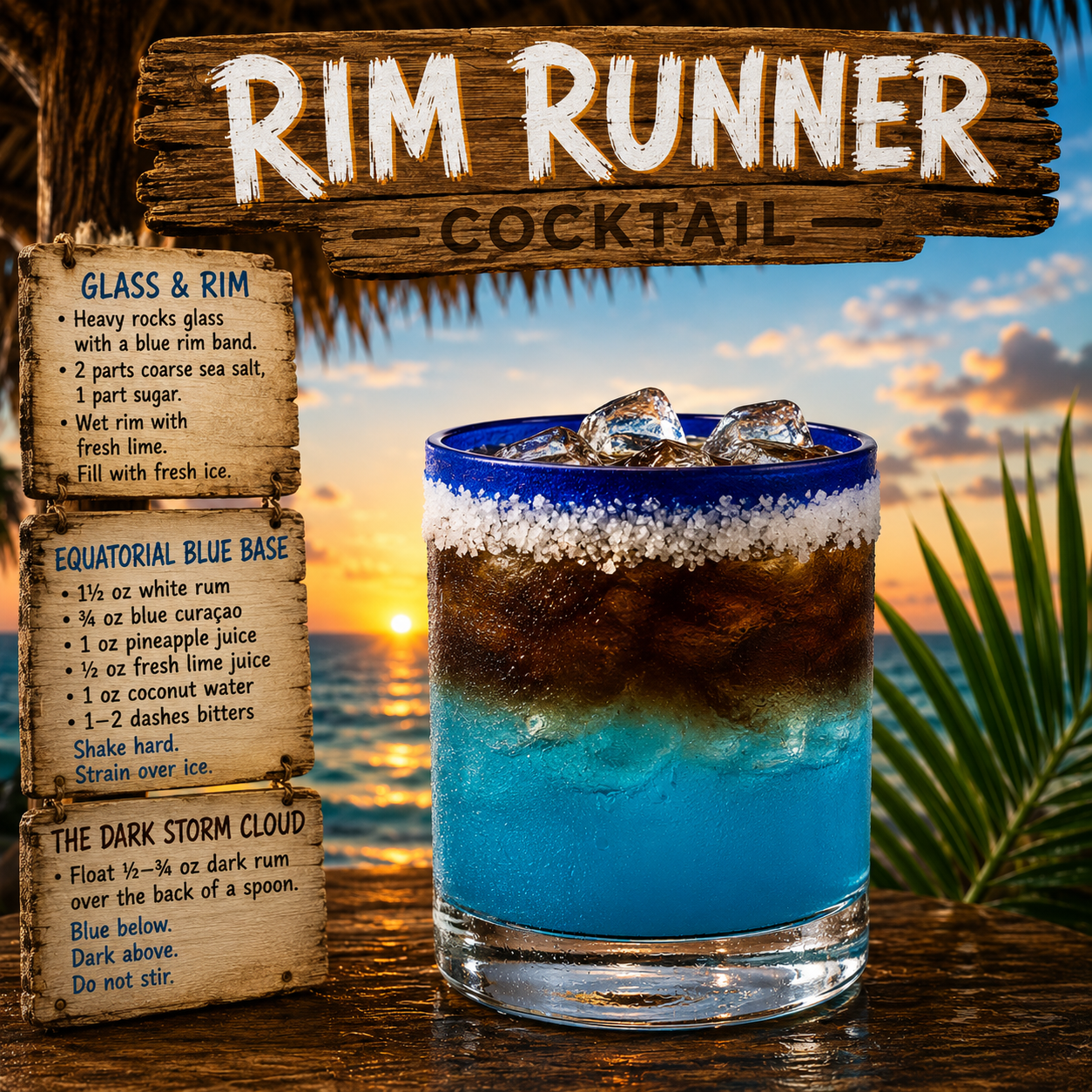
Heavy straight-sided rocks glass with a blue rim band. Rim mix: 2 parts coarse sea salt, 1 part sugar. Wet the outside rim with fresh lime and dip. Fill with fresh ice.
1½ oz white rum • ¾ oz blue curaçao • 1 oz pineapple juice • ½ oz fresh lime juice • 1 oz coconut water • 1–2 dashes ginger or aromatic bitters. Shake hard ~10 seconds. Strain over fresh ice.
Float ½–¾ oz dark rum over the back of a bar spoon. Blue below. Dark above. Salt and sky at the rim. Do not stir.
Same blue base. Float ½–¾ oz bourbon instead of dark rum. The bourbon is the star — the first nose, first sip, and finish live in that top layer.
Pineapple juice, coconut water, orange juice, lime, blue curaçao syrup (NA). Float iced tea or cola as the storm band. Same glass. Same rim. Same protocol.
The Rim Runner™
Rim Lightning — 1984 · The origin
Blue Rim 5™ • Catamaran Dan • Nevado Raiders™
The mission moves whether or not it is supported. But the right support — from the right people and institutions — determines how far it reaches, how many reefs get documented, how many coastal communities benefit, and how much of this story the world gets to hear.
Support expanded reef observation, improved data collection, and the environmental measurement capability that makes this data worth having for institutions and conservation organizations worldwide.
Support →Become part of the Nevado Raiders™ — disciplined sailors on real boats who understand that genuine respect for these coastlines and the people who live on them is the only operating standard that matters.
About →Track the expedition, the reef record, the imagery, and the broader Blue Rim 5™ global sailing story as it grows from Caribbean fieldwork into a larger long-range adventure.
Explore →